

News
 (5.0)
(5.0)
What are Demolition Hammers?
Demolition hammers are purpose-built power tools engineered for high-impact concrete and masonry removal. Unlike general drilling tools, they operate in hammer-only mode and are optimized for sustained material breaking rather than hole drilling. In modern construction, renovation, civil engineering, and industrial maintenance, demolition hammers play a central role in structural removal, floor stripping, trenching, and surface preparation.
This guide provides a comprehensive, technically accurate overview designed for informed procurement and operational decision-making.
What Exactly is a Demolition Hammer?
A demolition hammer—sometimes referred to as a concrete breaker or electric breaker—is a heavy-duty impact tool designed to fracture rigid materials such as:
Reinforced concrete
Asphalt
Brick and masonry
Stone
Tile and mortar beds
Unlike a rotary hammer, a demolition hammer does not rotate the bit. It delivers repeated linear impact energy through a chisel or point, concentrating force into a confined surface area to induce cracking and structural failure.
Core Functional Characteristics
Hammer-only mechanism
High impact energy (measured in Joules)
Robust gearbox and housing
SDS-Max or hex shank tool holder systems
Designed for continuous-duty demolition applications
Demolition hammers range from compact 5–8 kg models used for tile removal to 15–30 kg heavy-duty breakers intended for structural concrete demolition.
In industrial contexts, these tools are engineered for:
High thermal tolerance
Reinforced internal components
Long service intervals
Reduced vibration transmission
They are fundamentally impact-optimized machines, not modified drills.
How a Demolition Hammer Works
Understanding the internal mechanism clarifies why demolition hammers outperform general-purpose tools in heavy breaking tasks.
Impact Mechanism
Most electric demolition hammers use a piston-driven hammering system, powered by either:
Brushed motor systems
Brushless motor systems (in advanced industrial models)
The motor drives a crankshaft, which moves a piston inside a sealed cylinder. Compressed air transfers kinetic energy to a striker, which then impacts the tool bit. This indirect air-cushion system:
Reduces mechanical wear
Enhances impact consistency
Protects internal components
Key Performance Metrics
Impact Energy (Joules): Determines breaking force per blow
Blows Per Minute (BPM): Frequency of impacts
Motor Power (Watts or Amps): Indicates electrical input capacity
Weight (kg): Influences impact force and downward pressure
Higher Joule ratings typically correlate with increased concrete-breaking capability. However, energy efficiency, strike precision, and vibration management also influence real-world performance.
Vibration Control Systems
Professional-grade demolition hammers integrate:
Counterbalance mechanisms
Floating handles
AVS (Anti-Vibration Systems)
Shock-absorbing housings
These systems reduce Hand-Arm Vibration Syndrome (HAVS) risk and increase operator endurance during extended demolition cycles.
Which Type Fits You?
Demolition hammers are categorized based on power source, size class, and intended workload.
By Size and Application
Light-Duty Demolition Hammers (5–8 kg)
Ideal for tile removal and light masonry work
Easier overhead handling
Lower impact energy
Medium-Duty Demolition Hammers (8–15 kg)
Floor removal
Channel cutting
General renovation
Heavy-Duty Concrete Breakers (15–30 kg+)
Structural slab demolition
Foundation removal
Road and asphalt breaking
Heavy-duty models deliver significantly higher impact energy and are engineered for continuous industrial use.
By Power Source
Corded Electric Demolition Hammers
Stable power output
Suitable for prolonged use
Preferred for construction sites with reliable power access
Cordless Demolition Hammers
Increasingly viable with high-capacity lithium-ion batteries
Improved jobsite mobility
Reduced cable hazards
Modern cordless systems now compete with mid-range corded units in impact performance, making them suitable for professional use cases.
By Tool Holder System
SDS-Max: Common in mid-weight demolition hammers
Hex Shank (17mm, 19mm, 28mm): Used in heavy-duty breakers
Hex systems provide enhanced torque resistance and structural durability for high-impact applications.
Demolition Hammer vs Rotary Hammer
Although often confused, demolition hammers and rotary hammers serve different purposes.
| Features | Demolition Hammer | Rotary Hammer |
| Function | Hammer-only | Drill + Hammer |
| Bit Rotation | No | Yes |
| Typical Use | Breaking concrete | Drilling anchor holes |
| Impact Energy | Higher | Moderate |
| Continuous Demolition | Yes | Limited |
A rotary hammer is ideal for drilling holes into concrete for anchors and fasteners. A demolition hammer is engineered specifically for material removal and structural breaking.
Using a rotary hammer for heavy demolition can result in:
Premature gearbox wear
Overheating
Reduced productivity
Mechanical failure
Tool selection should align with task intensity and duty cycle.
Recommendation
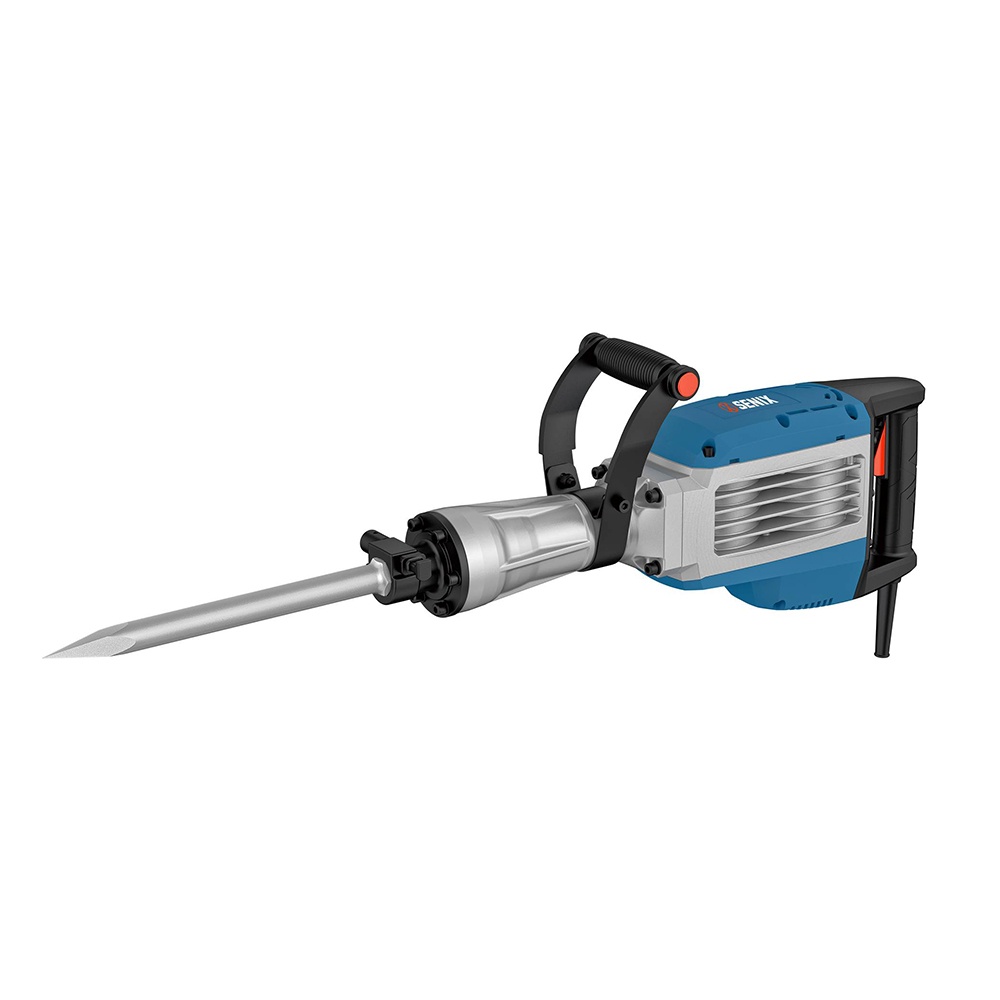
SENIX 1700W 30mm(1-1/4'') Demolition Hammer
Power That Breaks Limits. Performance You Can Trust.
When the job demands maximum impact and uncompromising durability, our 1700W Demolition Hammer delivers. Engineered for professional contractors and heavy-duty applications, this powerhouse combines 55J of impact energy, rugged construction, and ergonomic control to make even the toughest demolition tasks efficient and manageable.
Why Choose SENIX 1700W Demolition Hammer?
Massive 55J impact force for high-efficiency demolition
Industrial-grade durability for demanding job sites
Enhanced operator comfort for extended use
Reliable, consistent performance under heavy load
-
senix@senix.co